Otherwise, please select your country so we can show you products & currency for your location
The content of our website is always available in English and partly in other languages. Choose your preferred language and we will show you the content in that language, if available.
Quantitative PCR (qPCR) is a cornerstone of molecular biology, used for applications ranging from gene expression analysis to pathogen detection. However, accurate qPCR results depend on precise liquid handling, making pipetting a critical yet time-consuming step.
Today, labs face a crucial decision: Should they rely on manual pipetting, adopt semi-automation, or transition to fully automated liquid handling? Understanding that the path to automation is a journey, not a destination, we’ll explore the advantages and trade-offs of each approach, helping you determine the best fit for your lab’s needs.
The qPCR Bottleneck: Why Pipetting Matters
Pipetting in qPCR isn’t just about transferring liquid—it’s about ensuring reproducibility, minimizing contamination, and achieving accurate quantification. Errors in pipetting can lead to inconsistent Cq values, invalid data, and wasted resources.
Challenges include:
• Time-Intensive Protocols: Pipetting multiple samples manually can take 45+ minutes per plate.
• Human Error & Fatigue: Variability in pipetting can impact precision and accuracy.
• Cross-Contamination Risks: Inconsistent technique may introduce errors in high-sensitivity assays.
Comparing Three Pipetting Solutions for qPCR
A recent study evaluated three liquid handling approaches:
• Minimal user involvement with full walk-away automation
• Execution Time: ~5 minutes per plate
• Tip Consumption: Moderate (191 tips per run)
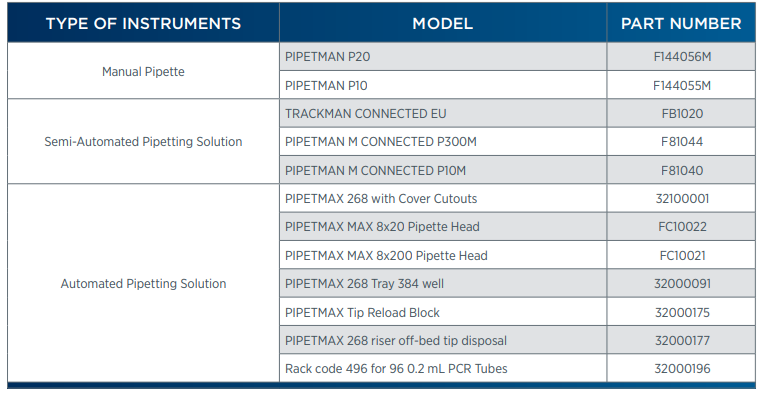
Figure 1. Gilson Material Details with Associated Part Number
What Does the Data Say?
The study showed that all three pipetting solutions produced comparable qPCR results, with efficiencies ranging between 90% and 110%, aligning with MIQE guidelines. However, the key differences were in execution time and operator dependency:
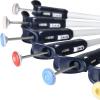
• Manual Pipetting: Most flexible but slowest and labor-intensive.
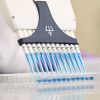
• Semi-Automation: Balanced approach offering traceability and efficiency.
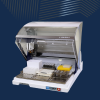
• Full Automation: Fastest and most reproducible, freeing up technician time.
• If you need maximum flexibility: Manual pipetting is suitable for small-scale or infrequent qPCR workflows.
• If you want efficiency without full automation, Semi-automation provides better consistency and traceability while reducing workload.
• If high-throughput and precision are priorities: Full automation delivers the fastest, most reproducible results with minimal hands-on time.
Conclusion & Next Steps
Adopting the right qPCR pipetting solution can significantly impact your workflow’s efficiency and data quality. While all methods yield accurate results, automation offers the best time savings and reproducibility.
Quantitative PCR (qPCR) is essential for gene expression analysis and pathogen identification in life science labs. While qPCR is sensitive, its plate preparation is time-consuming and requires skilled technicians. Automation enhances efficiency and reproducibility. This study compared manual pipettes, the semi-automated TRACKMAN® Connected, and the fully automated PIPETMAX® 268 liquid handler. All tools provided precise results with varying degrees of automation. Choose manual, semi-automated, or fully automated solutions to optimize processes, improve traceability, reduce errors, and free up time for critical tasks.